On July 4, 1776, the Continental Congress adopted a final Declaration of Independence, originally drafted by Thomas Jefferson (with changes by Benjamin Franklin and John Adams, and then alterations and deletions from discussions in session). Jefferson was the Chairman of the Committee of Five the Congress charged with writing it. After adoption on July 4, John Dunlap, printer to the Congress, worked all night to print copies of the Declaration that were sent to assemblies, conventions and committees and the commanders of the Continental troops.
On July 9th, New York at last approved the action of the Congress—the final one of the 13 to approve the document. On July 19th, Congress ordered the Declaration to be “engrossed” or written on parchment and signed by every member of the Congress. It was on August 2nd that John Hancock’s signature, as President of the Congress, was the first of the eventual 56 signatures on the Declaration.
The National Archives tells the story of the document itself and of its creation, with images that can be explored in detail on the National Archives.
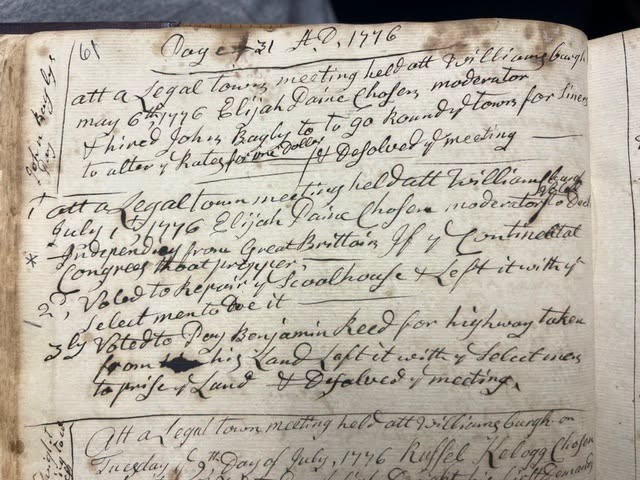
The residents of the nascent town of Williamsburg, Massachusetts, founded in 1771, registered their support. A few days earlier, the town had passed a resolution favoring independence. This act by townsfolk is recorded by hand in the original 18th-century minutes of Williamsburg’s early town meetings, as shown in the photographs. In the language and idiosyncratic spelling of the time, it reads: “Att a Legal town meeting held att Williamsburgh July 1t, 1776 Elijah Paine Chosen moderator Voted to Declare Independicy from Great Brittain If [the] Continental Congress thoat propper,— ”
The town voted for just three things at this meeting. The second article was to repair the schoolhouse and the third was to pay Benajmin Reed for land used for a town road. In both cases the voters “left it with [the] Selectmen” to take care of things.
In July of 1776, the people of Williamsburg took independence in their stride while still dealing with the practical needs and tasks of the running their small town, like education, building repairs and creating and maintaining roads. Daria D’Arienzo, Meekins Archivist. #throwbackthursday; #tbt.
Posted to Facebook 7/30/26