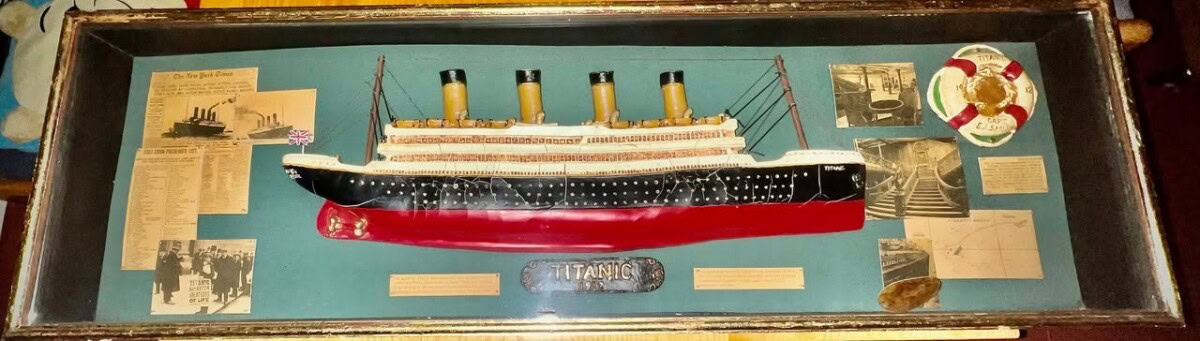
Tucked up in the Local History nook in the Meekins Library, you can find a small display case chronicling the story of the RMS Titanic. This home-made display was the gift of a library patron, many years ago. The red, white and blue rendition of the ship, with small vintage photographs and news clippings, and even a miniature life ring, draws browsers who catch a glimpse of it.
The RMS Titanic left Southampton England, on April 10, 1912, and on the next day (April 11), the luxury liner anchored off Roches Point, Queenstown (now Cobh), Ireland, destined for New York. There was not a dock large enough there to accommodate this great passenger ship. Passengers and mail were loaded by tender (smaller boats) from the shore. At more than 882 feet long, this largest ship of its time was designed for luxury and speed. It could carry 2,435 passengers and 885-900 crew. The captain was Edward John Smith, on his final voyage before retirement. With its 16 watertight compartments, the Titanic was considered unsinkable.
Just before midnight, on April 14, 1912, on her maiden voyage, the ship struck an iceberg in “Iceberg Alley”, south of Newfoundland, Canada, in the North Atlantic which ripped a series of gaps and bent steel plates in her starboard (right) side, water flooding 5 of the compartments. Two hours and forty minutes later, at 2:20 a.m. on April 15, 1912, she sank. There were only 20 lifeboats, not enough to evacuate everyone on board. Of the approximately 2,220 passengers and crew aboard, about 1,500 died in the icy waters. The 700+ survivors (the majority first- and second-class passengers in the lifeboats) were rescued by the RMS Carpathia. Most of those in the frigid water died within minutes. World-wide shock, outrage, and deep grief followed. The tragedy was widely covered in the press of the time, the disaster led to many changes in safety regulations. It remains one of the worst nautical disasters ever.
More than 100 years later the story of the Titanic continues to interest people. The story has been told in, among others, books, musical compositions, dance, and film, including “A Night to Remember” (1958) and “Titanic” (1977). The Meekins Library has numerous resources to explore both the facts and the folklore of the Titanic disaster. Explore online at (https://meekins-library.org) or come in and see what the library has to offer. Daria D’Arienzo, Meekins Archivist. #throwbackthursday; #tbt.
Posted to Facebook 4/9/2026